
SEO and PPC working together is the plan most trade businesses end up on, but the order matters. PPC means pay per click, ads where you pay each time someone clicks, like Google Ads. SEO means search engine optimization, the work that earns your free spot in Google’s map and results.
Here is the short version. Google Ads bring calls this month. SEO keeps calls coming after you stop paying. The two share one foundation, and if that foundation is broken, both waste money.
Harvest Digital Marketing runs Google Ads and local SEO for trade businesses in Doylestown, Newtown, Lansdale and West Chester. Below is the order we use and the reason for each step.
What this post covers
- The short answer: which one comes first
- Why Google Ads usually goes first
- What SEO does that ads cannot
- How ads data tells you which SEO pages to build
- The shared foundation both depend on
- What running only one costs you
- What to do this week
The short answer: Google Ads for calls now, SEO for calls later
Start Google Ads first if you need calls in the next 30 days. Build SEO at the same time, because it takes months to pay off and every month you wait pushes that payoff further out.
The two run on different clocks. A Google Ads search campaign can put you at the top of the page the day it goes live. We plan for about 30 days of learning before we judge one, and every change to the bidding strategy starts a fresh learning period of a week or two.
SEO moves slower. We tell every client to expect 3 to 6 months. Google’s own SEO starter guide says some changes take effect in a few hours and others could take several months.
So the real question is not SEO or Google Ads. It is how much of each, in what order, and when to shift the money toward whichever one books jobs for less.
Why Google Ads usually goes first for a trade business
Google Ads goes first because it answers one question fast: will people in your area pay for this service at a price that works? You learn that in weeks, not quarters.
A furnace that quits in January does not wait for your blog to rank. The homeowner in Lansdale searches, calls one of the first few names, and books. Ads put you in that spot while your organic rankings are still climbing.
Ads also give you control. You pick the services, the towns, the hours, and the page each click lands on. You can pause a service the week your crew is full.
The catch is that ads stop the second you stop paying. They rent attention. That is fine for a start, but a business that only rents never builds anything it owns. Our Google Ads for trades work starts lean for exactly that reason: prove the cost per booked job first, then scale.
What SEO does that ads cannot
SEO builds calls you do not pay for each time. Once a service page ranks in the top three for “water heater replacement” near Newtown, every call from it costs nothing extra.
SEO also covers ground ads skip. Some homeowners skip anything marked Sponsored and go straight to the map and the free listings. Google’s map results lean on your Google Business Profile, your free listing with your hours, reviews and photos, so that work counts as SEO too.
It compounds. A page that ranks keeps working while you sleep, through slow months, and after your ad budget is gone. Reviews collected this year still help next year.
The tradeoff is time and patience. SEO asks you to keep doing the work for months before the phone proves it worked. That is why it pairs so well with ads: the ads pay the bills while local SEO for trade businesses builds the asset you own.
How SEO and PPC work together: ads data picks your SEO pages
The best reason to run both is that Google Ads tells you which SEO pages to build first. You stop guessing which services and phrases are worth months of effort.
Every Google Ads account has a search terms report, the list of what people actually typed before they clicked your ad. Google’s search terms report guide explains how to read it. Match those searches against your calls and you see which phrases turn into booked jobs.
Say “sump pump replacement” calls book often while “plumber near me” clicks rarely call. That tells you to build and strengthen a sump pump service page first, with the exact words homeowners use.
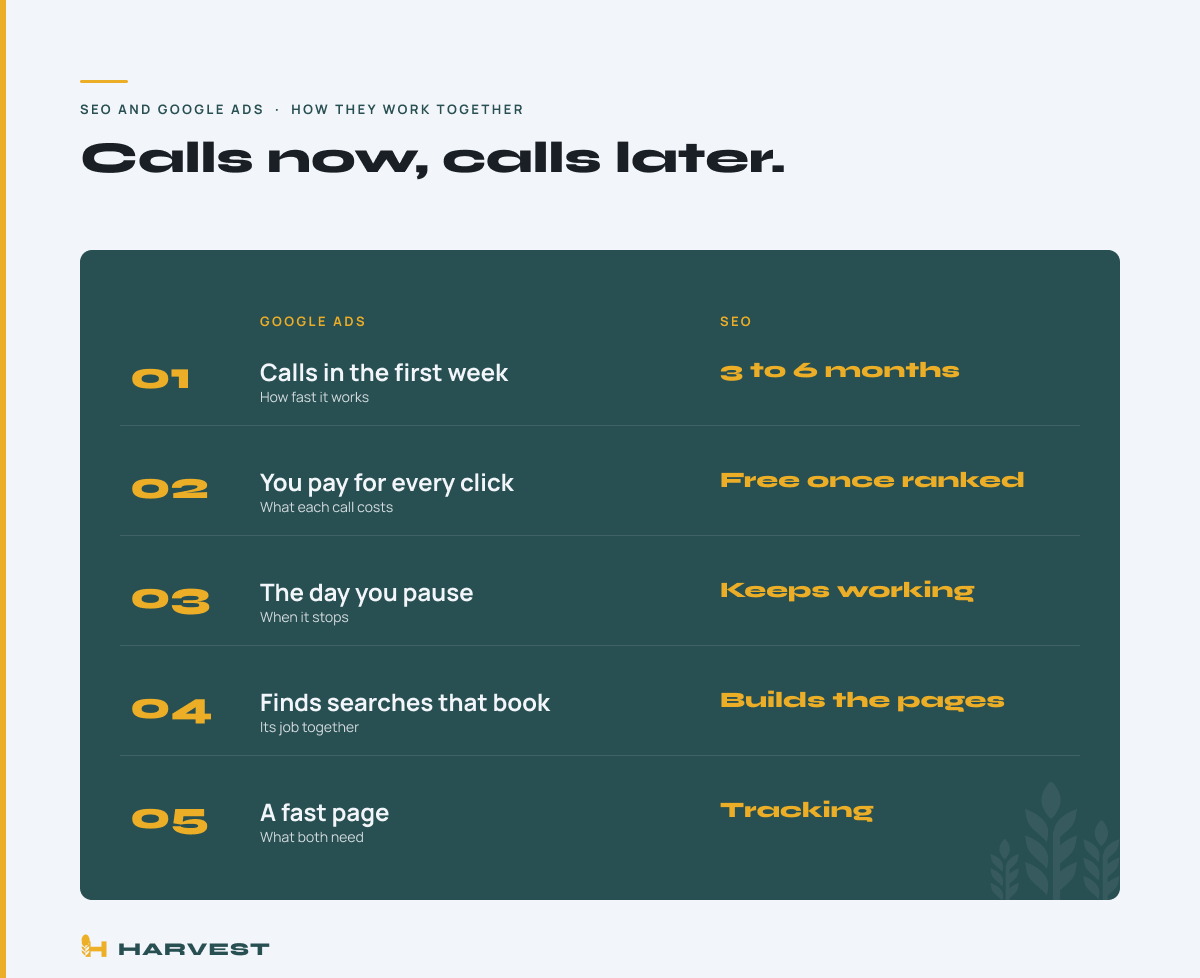
It works the other way too. Once a page ranks in the top three and calls hold steady, you can trim ad spend on that service and move it to one that still needs paid help.
The shared foundation both depend on
SEO and Google Ads both send people to the same website and the same phone. If the page is slow or nobody can see what happened after the click, both channels leak money.
We pulled public data on Bucks County trade companies in October. Of 129 sites we speed tested on mobile, 121 missed Google’s 2.5 second mark for Largest Contentful Paint (LCP), the time it takes the main image or text to appear. The middle site took 10.9 seconds. Full numbers are in our post on SEO mistakes small businesses make.
Of 263 homepages we could read, 102 showed no Google tracking code in the page source. That is a ceiling, since some builders add tags later, but it means many owners cannot tell which channel made the phone ring.
Fix these first. A fast page with contractor web design built to turn clicks into calls and working call tracking makes every ad dollar and every ranking worth more.
What running only one actually costs you
Running only one channel costs you either time or money. Ads alone cost money forever. SEO alone costs months of slow phones.
Run this example on your own numbers. Say you spend $1,500 a month on Google Ads and pay $90 per lead. That is roughly 16 leads a month, and zero the week the card declines or you pause.
Now say a service page starts ranking in month five and brings 6 calls a month on its own. Your total leads go up, and your cost per lead across both channels drops, because 6 of those calls cost nothing extra.
SEO alone has its own price. If you need 15 jobs a month to keep the crew busy and organic brings 4 while it grows, the gap is real revenue lost for a season. Starting ads lean while SEO builds is how you avoid paying either price in full.
What to do this week
- Write down your ceiling: average job value, close rate, and the most you can pay for one lead.
- Run your homepage and your top service page through PageSpeed Insights on mobile. Note the LCP number.
- Check that calls and form fills are tracked, so you can tell which channel booked each job.
- If you run Google Ads now, open the search terms report and list the five phrases that brought real calls.
- Make sure each of those five services has its own page on your site.
- Count your Google reviews against the top three names on the map for your main service.
Not sure where your calls go now? See where you’re losing leads and get a plain breakdown of where calls slip away and who is getting them. If you are weighing Google’s pay per lead option too, read Local Services Ads vs Google Ads.
Frequently asked questions
Should a small trade business do SEO or Google Ads first?
Most should start Google Ads first if they need calls this month, while they fix the website and Google Business Profile that SEO depends on. Start with SEO first if your ad budget is under a few hundred dollars a month or your crew is already booked solid.
How long does SEO take compared to Google Ads?
Google Ads can bring calls in the first week, and we plan for about 30 days of learning before judging a campaign. SEO usually takes 3 to 6 months to move. Google’s own starter guide says some changes take a few hours and others take several months.
Does running Google Ads help my SEO rankings?
No. Paying for ads does not raise your organic ranking. Ads help SEO indirectly: the search terms report shows which real searches turn into calls, so you know which service pages to build and improve first.
Can I stop Google Ads once SEO starts working?
You can scale ads down for services where you rank in the top three and the calls hold steady. Most trade businesses keep a smaller budget running for emergency work, new services and slow months, because organic rankings can shift.
How much should I spend on SEO versus Google Ads?
There is no fixed split. Start ads lean, with a budget your numbers can carry, and scale only when cost per booked job proves out. Put steady monthly effort into SEO, then shift budget toward whichever one books jobs for less.
For bigger planned jobs, Meta Ads for homeowners in your area plant the idea before anyone searches. For a straight answer on your business, book a free 15 minute strategy call or contact Harvest Digital Marketing. We work month to month, and you can cancel with 14 days notice.
