

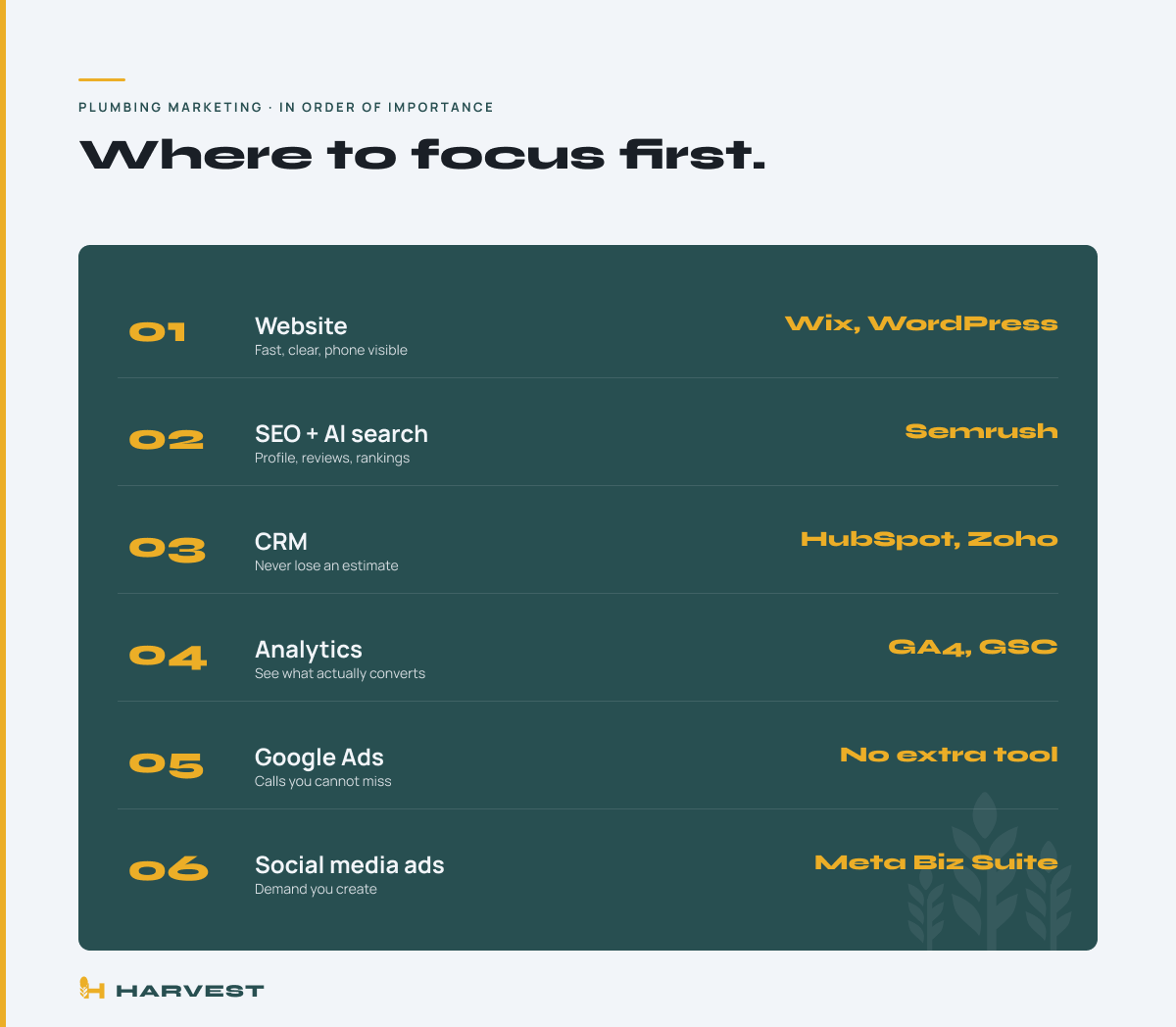
If you are searching for how to market a plumbing business yourself, start from a fact most plumbing advice skips: nobody can see your work. Six channels are worth your time, in this order. Website, then getting found on Google, then a system for remembering customers, then checking what is working, then Google Ads, then Facebook and Instagram ads.
A roofer can point a phone at a finished job from the street. A plumber’s best work is behind drywall or under a slab, where nobody will ever look at it again. That changes which channel earns trust first, and it starts with a number worth sitting with.
What this post covers
- What 67 local plumbing companies score on reviews, and why the bar is higher here
- How slow their websites load on a phone during an emergency
- Why hidden work means reviews carry more weight than photos
- A tracking system built around remembering repeat customers, not just today’s estimate
- Why the ugly photo beats the pretty one on Facebook and Instagram
- Where Google Ads fits, and why it needs no extra tool
1. Website
On 16 September 2026 we ran Google’s free speed test on the websites of the 30 Bucks County plumbing companies with the most Google reviews.
The middle score was 53 out of 100. Not one broke 90, the score Google calls good.
Load time is the number that costs jobs here. The middle site took 6.4 seconds to show its main content, well past Google’s 2.5 second target, and 29 of the 30 missed that target.
Someone with water on the floor gives your site about three seconds on a phone before they hit back and call the next name. A slow load during an emergency call is not a minor inconvenience, it is a lost customer, every time.
Keep the phone number tappable on every page, state your service area plainly, and give each service its own page: drain cleaning, water heaters, repipes, sump pumps. None of that fixes a slow load on its own, so also shrink any job photos before upload instead of leaving them full size.
Wix and WordPress both let a plumbing owner build and maintain a site like this without hiring a developer. Wix is the faster start with no technical background. WordPress does more once you learn it.
2. Getting found on Google
Reviews matter more in plumbing than almost any other trade, because they are the only proof a homeowner gets before they let a stranger into their house. Across the 67 companies we found, the middle one had 62 reviews.
Twenty six of the 67, 39 percent, had already passed 100. Only 22, about a third, were under 25.
That is a higher bar than hardscape or general contracting see in this same county. Plumbing is an established, high volume trade, and most serious competitors already have real review counts. If you are under 25 here, you are not just behind average, you are behind most of the market.
The fix is still a habit, not a campaign. Ask for the review while you are standing in the kitchen at the end of the job, before you are back in the truck and it never happens.
That same completeness helps you show up in Google’s map results and in the AI answers homeowners now see alongside them, since both read the same things: a fully filled out Google Business Profile (your free Google listing), a real service area, current hours, and your license and insurance information where it is easy to find.
Semrush is a free tool that shows which plumbing searches you already show up for and which ones a competitor across town has quietly taken.
3. A system for remembering your customers
A plumber’s business is not really built on today’s estimate. It is built on the same address calling you again in three years for the water heater you can already guess is aging out.
That is different from a trade that sells one big visible job and hopes for a referral. A tracking system for plumbing earns its keep by remembering what you installed and when, not only who is waiting on a quote right now.
So log every job with the install date and the equipment, not just the estimate. A water heater installed five years ago is a warm lead for a replacement conversation nobody else is having with that homeowner, and a tool that surfaces it beats a memory that has to hold hundreds of addresses.
A tool like HubSpot or Zoho CRM does this for you for free to start. Both let you log a job once and search it years later, which a stack of invoices in a filing cabinet cannot do.
4. Checking what is actually working
Plumbing traffic moves with the weather in a way most trades do not. A freeze snap sends burst pipe searches up overnight, and that spike will make almost any change look like it worked, even one that did nothing.
Compare a normal week to a normal week, and a freeze week to last year’s freeze week, not to the month before it.
You need three answers. Which service pages get visits, how many of those visits turn into a call, and which searches already bring you traffic before you pay for more of the same.
Google Analytics and Search Console are two free tools from Google. Analytics shows you what people do on your site, and Search Console shows you what people typed into Google to find you. Check weekly here, since plumbing moves faster than a seasonal trade but the weather still muddies a daily read.
5. Google Ads
Google Ads earns its budget fastest in plumbing of any trade on this list, because the search and the emergency happen in the same five minutes. Nobody with a burst pipe is scrolling Facebook first.
Start with Local Services Ads. They are built for home service trades, sit above regular search ads, and charge per customer who contacts you instead of per click.
This is the one step on this list with no extra tool. Google Ads and Local Services Ads run inside Google’s own platform, and judge results on booked jobs, not clicks, since an emergency plumbing click is expensive and a slow page wastes every one you buy.
6. Facebook and Instagram ads
Facebook and Instagram ads come last for plumbing, and they work differently here than in a visible trade like hardscape or general contracting. Nobody is scrolling Instagram mid emergency, so these ads sell the planned jobs: a repipe, a water heater upgrade, a fixture replacement someone has been putting off.
The photo that works is not the pretty one. A finished bathroom looks nice, but a camera shot of roots choking a sewer line or a corroded pipe pulled out of a wall gets shared because it is a little bit gross and completely convincing. Relief sells here, not aesthetics.
Post real job photos, including the ugly before shots, for free first, before you spend a dollar to put any one post in front of more people (that is what “boosting” means).
Meta Business Suite is the free tool from Facebook itself, and it runs both your free Facebook and Instagram posts and your paid ads from one place.
What to do this week
Six things, one per channel, in the order that matters for this trade.
- Search “Google PageSpeed Insights,” put your own address in, and run it on mobile. A score near 53 is average for this county, and average here is too slow for an emergency call.
- Count your Google reviews. Under 62 puts you behind the middle of this market, so ask your next three customers while you are still in the house.
- Open a free HubSpot or Zoho account and log every job with an install date and equipment note, not just today’s open estimates.
- Confirm Analytics and Search Console are installed, then compare this week to a normal week last year instead of to last month.
- Find one ugly before photo from a recent job (a corroded pipe, a root filled line) and post it to Facebook or Instagram this week.
- Start the Local Services Ads background check now if you have not already, since approval takes time you do not want to lose during a freeze week.
That is a full list to run between service calls, especially during a freeze week when every call is an emergency. If it needs a team instead of a slow Tuesday, see where you’re losing leads for a plain read on what is and is not working, or see how plumbing companies market with Harvest.

Frequently asked questions
How many Google reviews does a plumber need to compete in Bucks County?
More than you would guess. We found 67 plumbing companies across Doylestown, Newtown, Warminster, Chalfont and Perkasie on 16 September 2026. The middle company had 62 reviews, and 26 of the 67 (39 percent) had already passed 100. A third had under 25. Plumbing has a higher review bar than most trades in this county because so many established companies already cleared it.
How fast do plumbing company websites load on a phone?
Slower than an emergency call can wait for. We ran Google’s free speed test on the 30 plumbers with the most reviews. The middle score was 53 out of 100, none broke 90, and the middle load time was 6.4 seconds against Google’s 2.5 second target. Twenty nine of the 30 missed that target.
Why does a plumbing company need a different kind of tracking system than a roofer or an electrician?
Because you cannot see the work. A finished roof or a new EV charger can be photographed. A properly soldered joint behind drywall cannot. That means a plumber’s proof has to come from review volume and from remembering the same customer’s whole history, not from a portfolio, so a tracking system that logs install dates and past jobs per address matters more here than in a visible trade.
What kind of photo actually works for plumbing on Facebook or Instagram?
The ugly kind, not the pretty kind. A patio or a finished panel sells on looks. A plumbing before and after sells on relief: a camera shot of roots inside a clogged line, a corroded pipe pulled out of a wall, a water heater that was quietly rusting through. Homeowners share the gross photo, not the neat one.
Should a plumber run Google Ads or Meta Ads first?
Google Ads first, and it is not close. Someone with water on the floor is searching Google in the next five minutes, not scrolling Facebook. Meta Ads come second, for the planned work: water heater upgrades, repipes, fixture replacements someone has been putting off. Book a free 15 minute strategy call to talk through the right order for your business.
A middle score of 53 and 39 percent of the market already past 100 reviews means plumbing is not an easy field to walk into. It is a field where the site has to load fast enough to catch an emergency, and the review count has to already be real before anything else works.
That means the plumbing company that fixes its load time, keeps asking for reviews after every job, and remembers its own customers wins on trust instead of on budget. If you would rather have the local SEO and web design side handled for you, along with Google Ads and Meta Ads, contact Harvest Digital Marketing for a plain look at what makes sense next.